
Why Is My HVAC Energy Bill Suddenly Higher?
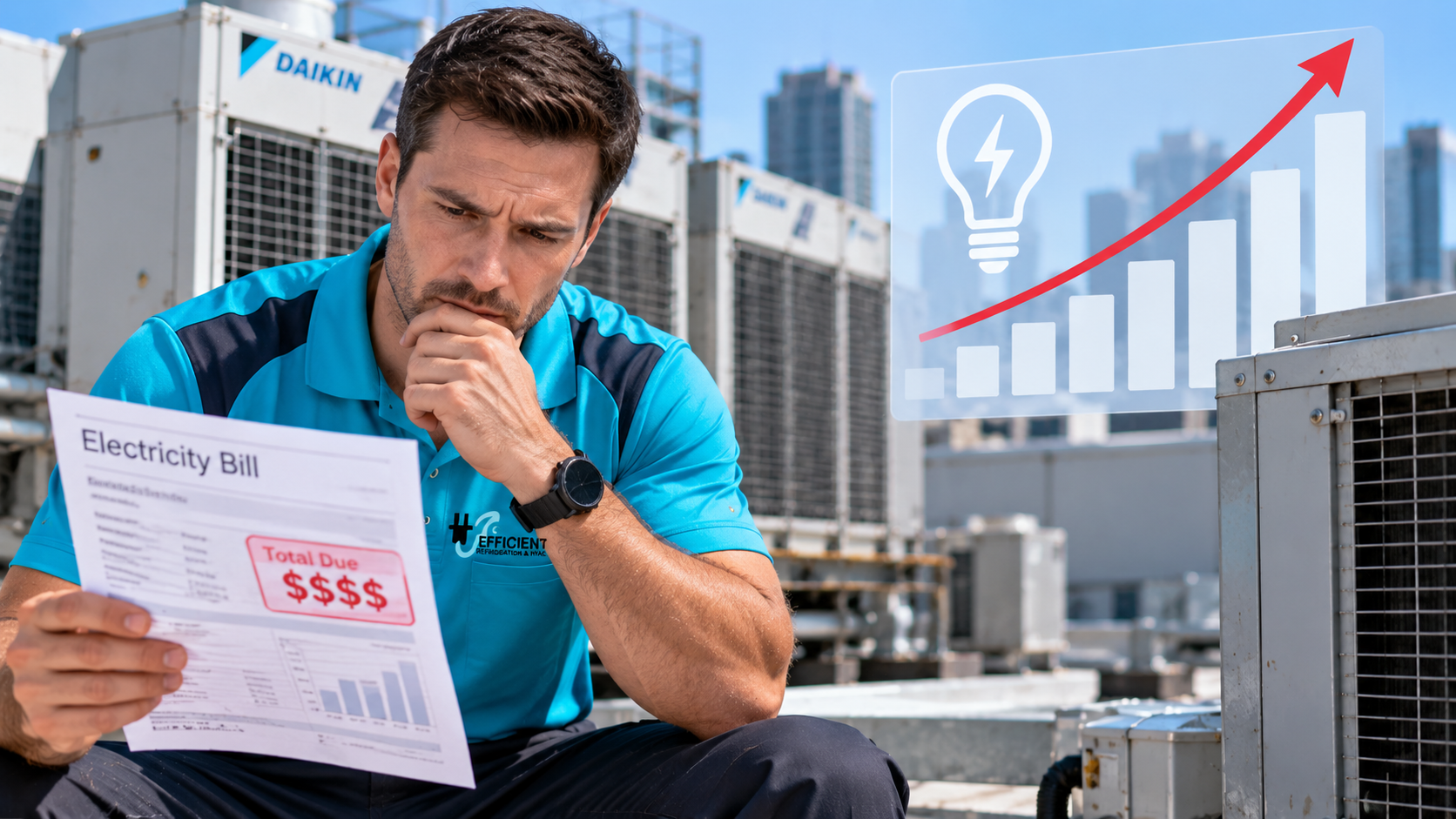 If your commercial HVAC energy bill is suddenly higher, there may be an underlying problem with the way your air conditioning system is operating.
A sudden increase in energy consumption can be caused by dirty filters, restricted airflow, poor maintenance, faulty controls, refrigerant problems, ageing equipment or changes in building use.
Commercial HVAC systems can consume a significant amount of electricity, especially when they operate for long periods during hot weather. When a system starts working harder than necessary, energy consumption can increase before an obvious equipment failure occurs.
Understanding what is causing the increase can help businesses identify developing problems, manage operating costs and avoid unnecessary HVAC downtime.
What Causes a Commercial HVAC Energy Bill to Increase?
There is rarely one single reason for a higher HVAC energy bill.
Your commercial air conditioning system may be responding to higher outdoor temperatures, increased building occupancy or longer operating hours. However, increased energy use can also indicate that equipment is no longer operating efficiently.
Common causes include:
- Dirty or blocked filters
- Poor airflow
- Dirty evaporator or condenser coils
- Faulty HVAC controls
- Refrigerant problems
- Worn fans and motors
- Compressor problems
- Poorly maintained equipment
- Ductwork problems
- Incorrect temperature settings
- Longer operating hours
- Increased building occupancy
- Ageing HVAC equipment
- Equipment operating outside its intended conditions
The first step is to determine whether energy consumption has increased because the building requires more cooling or because the HVAC system is becoming less efficient.
1. Dirty Air Filters Can Increase Energy Consumption
Air filters are an important part of commercial HVAC maintenance.
When filters become blocked with dust and debris, airflow through the system can become restricted.
The HVAC system may then need to operate for longer to provide the required level of cooling.
In a commercial building, this can become particularly noticeable when the system is already operating under heavy demand.
Dirty filters can also contribute to other performance problems if they are not addressed.
Regular inspection and replacement of filters should therefore form part of a preventative maintenance program.
The correct maintenance frequency depends on the equipment, building conditions and operating environment.
2. Poor Airflow Can Make Your HVAC System Work Harder
Your commercial HVAC system needs adequate airflow to operate effectively.
Restricted airflow can be caused by dirty filters, blocked grilles, dirty coils, fan problems, damaged ductwork or other mechanical issues.
When airflow is reduced, the system may struggle to distribute conditioned air throughout the building.
This can lead to longer operating periods as the system attempts to reach the required temperature.
You may also notice uneven temperatures between different areas of the building.
If some rooms feel comfortable while others remain too warm or too cold, airflow should be considered as part of the investigation.
3. Dirty Coils Can Reduce HVAC Efficiency
Coils play an important role in transferring heat within an air conditioning system.
Over time, dust and dirt can accumulate on coils.
This can reduce the system’s ability to transfer heat effectively and may increase the amount of work required to provide the required cooling.
Commercial buildings can be exposed to significant amounts of dust, particularly where HVAC equipment operates in demanding environments.
Coil cleaning should therefore be included in an appropriate preventative maintenance program.
Cleaning should be carried out according to the equipment manufacturer’s requirements and the operating conditions of the site.
4. HVAC Controls May Be Increasing Energy Use
Modern commercial HVAC systems often rely on controls to manage temperature, schedules and equipment operation.
If controls are incorrectly configured or a component develops a fault, equipment may operate when cooling is not required.
For example, a system could be running outside normal business hours or maintaining temperatures that are lower than necessary.
Small changes in operating schedules can have a noticeable effect when large commercial HVAC systems are involved.
A review of HVAC controls can help determine whether equipment is operating according to the building’s actual requirements.
5. Refrigerant Problems Can Affect System Performance
Refrigerant problems can also affect commercial air conditioning performance.
A refrigerant leak or another refrigeration fault can reduce the system’s ability to provide effective cooling.
The equipment may then operate for longer periods while attempting to achieve the required indoor temperature.
If you notice that your system is running continuously, struggling to cool the building or showing other unusual symptoms, refrigeration performance should be assessed.
Simply adding refrigerant without identifying the underlying problem is not a long term solution when a leak or system fault is present.
6. Worn Fans and Motors Can Increase Energy Consumption
Fans and motors are essential components of commercial HVAC systems.
As equipment operates over time, components can wear.
Bearings, belts, motors and other components may develop problems that affect system performance.
A worn component does not always result in an immediate breakdown.
Instead, the equipment may continue operating while becoming less efficient or producing unusual noise or vibration.
This is one reason why preventative maintenance is important.
Identifying developing mechanical problems early can help businesses address issues before they contribute to larger equipment failures.
7. Compressor Problems Should Not Be Ignored
Compressors are among the most important components in many commercial air conditioning and refrigeration systems.
A compressor that is operating under abnormal conditions can affect overall system performance and energy consumption.
Potential problems can involve electrical components, operating conditions, refrigerant performance, controls or mechanical wear.
Because compressors can be expensive components, unusual operation should be investigated rather than ignored.
If your energy consumption has increased alongside changes in cooling performance, compressor operation should form part of a professional HVAC assessment.
8. Your Building May Simply Require More Cooling
Not every increase in energy consumption means that your HVAC system has developed a fault.
Changes in the building can increase cooling demand.
For example, your business may have:
- Increased staff numbers
- Increased customer traffic
- Extended operating hours
- Added computers or electrical equipment
- Added refrigeration equipment
- Changed internal layouts
- Increased production
- Started using previously unconditioned areas
All of these changes can affect the amount of cooling required.
This is why comparing energy consumption with building use is important.
If the building is using more energy because demand has increased, replacing equipment may not necessarily address the underlying reason for the higher consumption.
9. Hot Weather Can Increase HVAC Energy Use
Outdoor temperature has a direct impact on commercial air conditioning demand.
When temperatures rise, HVAC systems have to remove more heat from the building.
This can result in longer operating periods and higher electricity consumption.
Western Australian businesses can experience particularly high cooling demand during hot weather.
If your HVAC energy bill increases during a period of extreme temperatures, some of the increase may be associated with the additional cooling required.
However, a significant or unexpected increase should still be investigated, particularly if it continues after temperatures return to normal.
10. Incorrect Temperature Settings Can Increase Energy Costs
Temperature settings can also affect HVAC energy consumption.
Setting a commercial building to a significantly lower temperature does not necessarily mean it will cool faster.
Instead, the system may need to operate for longer to maintain the lower temperature.
Temperature settings should be appropriate for the building, its occupants and the type of business being operated.
Reviewing temperature settings can therefore be a simple part of investigating higher HVAC energy consumption.
11. Ductwork Problems Can Affect HVAC Performance
For systems that use ducted air distribution, the condition of the ductwork can influence system performance.
Leaks, damage or poor insulation can affect the delivery of conditioned air.
The HVAC system may continue operating while the building receives less effective cooling than expected.
This can result in longer operating periods.
If the system appears to be operating normally but certain areas are consistently difficult to cool, the air distribution system should be considered as part of the investigation.
12. Ageing Equipment May Be Using More Energy
Commercial HVAC equipment can operate for many years when properly maintained.
However, ageing equipment can experience component wear and changes in performance over time.
Older systems may also use technologies that are less efficient than newer commercial HVAC equipment.
This does not mean every older system needs to be replaced.
In some cases, appropriate maintenance or targeted component replacement may improve performance.
A professional assessment can help determine whether continued maintenance, repairs, upgrades or eventual replacement should be considered.
How Do You Know If Your HVAC System Is the Problem?
A higher energy bill by itself does not confirm that your HVAC system has a fault.
It is useful to look for other changes at the same time.
Warning signs can include:
- The system is running for longer than usual
- The building is taking longer to cool
- Some areas are warmer than others
- Airflow appears weaker
- The system is making unusual noises
- Equipment is cycling on and off frequently
- Indoor humidity has increased
- The system requires more frequent repairs
- Energy consumption continues increasing without a clear reason
When several of these signs occur together, it may be worth arranging a professional HVAC inspection.
Compare Your Current Energy Use With Previous Months
Before assuming there is an equipment problem, compare your current energy consumption with previous periods.
Look at:
- Electricity consumption
- HVAC operating hours
- Outdoor temperatures
- Building occupancy
- Business operating hours
- Changes to equipment
- Changes to temperature settings
- Recent HVAC maintenance
- Recent repairs
This information can help identify whether the increase is unusual.
For example, an increase during a period of significantly hotter weather may have a different explanation from an increase that occurs despite similar weather and building usage.
Why Preventative HVAC Maintenance Matters
Preventative maintenance is about more than preventing breakdowns.
It can also help identify developing problems that may affect equipment performance.
A commercial HVAC maintenance program may include:
- Filter inspection and replacement
- Coil cleaning
- Fan inspection
- Motor inspection
- Belt inspection
- Bearing checks
- Electrical inspections
- Airflow checks
- Refrigeration performance checks
- Compressor assessment
- Control testing
- Ductwork inspection
- Vibration checks
- Equipment condition reporting
The exact maintenance requirements should be based on the equipment, building use and operating environment.
Regular inspections can provide businesses with a clearer picture of how their HVAC equipment is performing over time.
Can Commercial HVAC Maintenance Reduce Energy Costs?
Regular maintenance can help identify conditions that may cause HVAC equipment to work harder than necessary.
For example, cleaning coils, maintaining airflow and identifying worn components can help support proper system operation.
However, maintenance is only one part of managing commercial HVAC energy consumption.
Energy use can also be affected by:
- Building design
- Equipment size
- Occupancy
- Weather
- Operating hours
- Temperature settings
- Equipment age
- Control strategies
- Electricity prices
For this reason, businesses should look at overall HVAC performance rather than focusing on one component.
What If Your HVAC Energy Bill Keeps Increasing?
If your energy consumption continues increasing without an obvious explanation, further investigation may be required.
A commercial HVAC technician can assess the system and look for potential causes such as:
- Poor airflow
- Dirty components
- Refrigeration problems
- Electrical issues
- Control problems
- Mechanical wear
- Compressor performance
- Incorrect operation
- Equipment capacity issues
The objective should be to identify why the system is consuming more energy rather than simply treating the higher bill as an unavoidable operating cost.
When Should You Arrange Commercial HVAC Service?
You should consider professional HVAC service if your energy consumption increases significantly and you cannot identify a clear reason.
It is particularly important to investigate when the higher energy bill occurs alongside other changes such as reduced cooling performance, unusual equipment noise, poor airflow or frequent system operation.
Early investigation may help identify developing problems before they become major repairs.
It can also give your business a clearer understanding of the condition and performance of its HVAC equipment.
How Efficient Refrigeration & HVAC Can Help
Efficient Refrigeration & HVAC provides commercial HVAC and refrigeration services across Perth and Western Australia.
Our team can assist businesses with commercial HVAC maintenance, repairs, servicing and system performance.
If your commercial HVAC energy bill is suddenly higher, investigating the cause early can help you understand whether the increase is related to building demand, equipment performance or an underlying HVAC problem.
A properly maintained commercial HVAC system can support reliable operation while helping businesses identify developing issues before they become more disruptive.
Need help with your commercial HVAC system?
Call 1300 189 336 or email service@eres.net.au to discuss commercial HVAC service and maintenance across Perth and Western Australia.