

Commercial HVAC BMS Optimisation: Improving Building Performance and Energy Efficiency
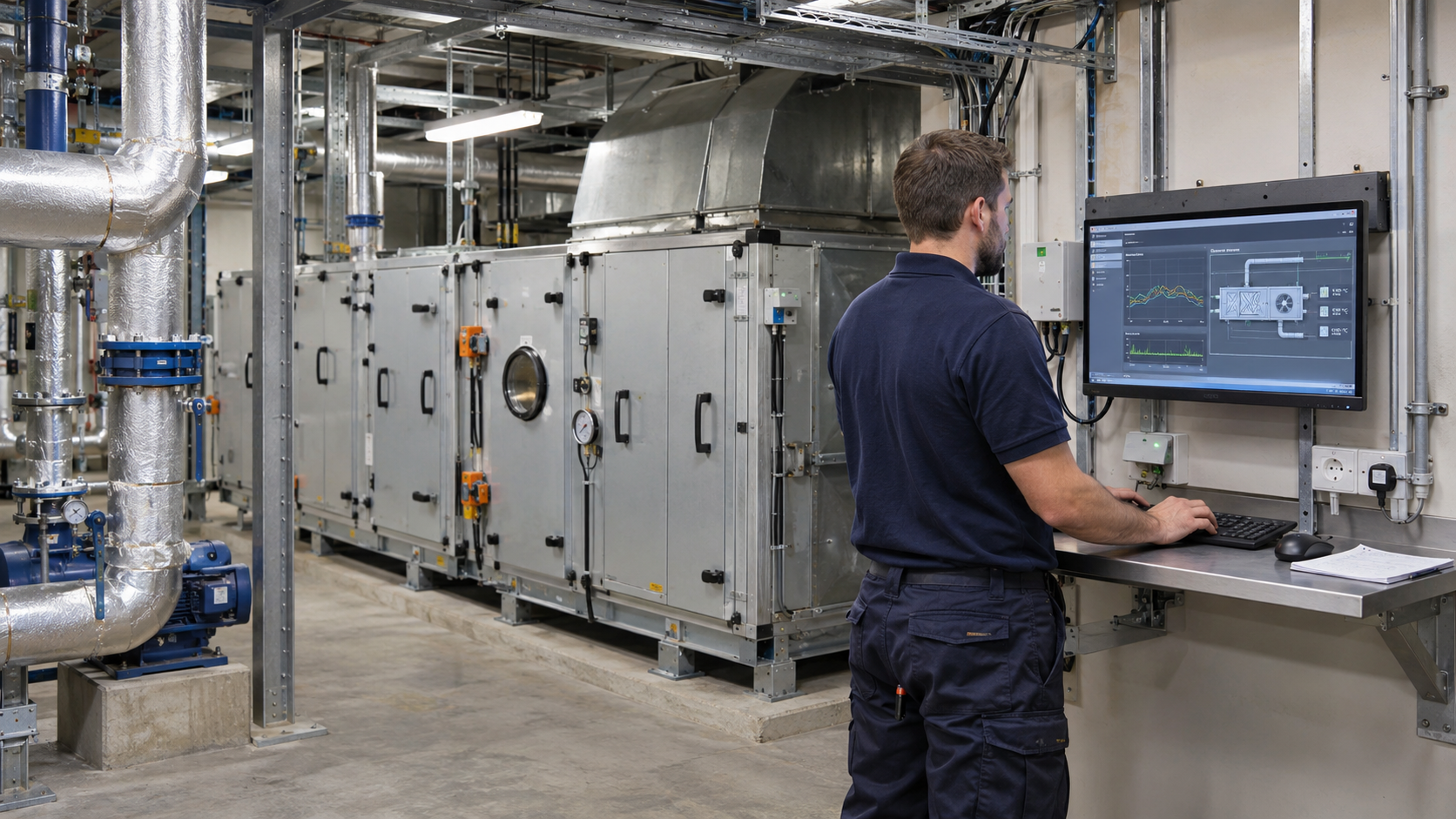 Commercial HVAC BMS optimisation plays an important role in improving building performance, controlling energy consumption and maintaining reliable heating and cooling. For large commercial buildings, poorly configured HVAC controls can result in unnecessary equipment operation, inconsistent indoor temperatures and rising operating costs.
A Building Management System (BMS) allows facility managers to monitor and control essential building services from a central platform. However, simply installing a BMS does not guarantee that a commercial HVAC system will operate efficiently. Incorrect temperature settings, poorly calibrated sensors, outdated control sequences and unsuitable operating schedules can all affect system performance.
For businesses managing large buildings, shopping centres, hotels, hospitals and industrial facilities, these problems can have a significant impact on operational efficiency.
Commercial HVAC BMS optimisation involves reviewing how building controls interact with mechanical equipment, identifying inefficiencies and adjusting system operation to meet actual building requirements.
Efficient Refrigeration & HVAC understands the importance of reliable commercial HVAC operation. By considering the relationship between mechanical equipment, controls and building demands, businesses can make better decisions about system performance, maintenance and future upgrades.
What Is a Building Management System (BMS)?
A Building Management System is a centralised platform used to monitor and control various mechanical and electrical services within a building.
In commercial HVAC applications, a BMS commonly monitors and manages:
- Heating, ventilation and air conditioning equipment.
- Chillers and chilled water systems.
- Cooling towers and associated pumps.
- Air handling units and ventilation systems.
- Temperature and humidity sensors.
- Fans, dampers and control valves.
- Operating schedules and equipment alarms.
- Energy consumption and system performance.
The system collects information from sensors and connected equipment. It then uses programmed control sequences to regulate how different components operate.
For example, a temperature sensor may detect that an occupied area is warmer than its required set point. The BMS can respond by adjusting cooling operation, opening a control valve or increasing airflow, depending on the system design.
This communication between building controls and mechanical equipment helps maintain the required indoor conditions.
However, the effectiveness of a BMS depends on the accuracy of the information it receives and the quality of its programming.
A poorly configured system can operate equipment unnecessarily or fail to respond correctly when building conditions change.
Why Commercial HVAC BMS Optimisation Matters
Commercial HVAC systems are responsible for a significant proportion of energy consumption in many commercial buildings. As a result, inefficient controls can create unnecessary operating costs.
According to the Australian Government’s energy.gov.au guidance, HVAC systems can account for up to 50% of a commercial building’s energy use.
This makes control optimisation an important consideration for businesses looking to improve building performance without immediately replacing major equipment.
There are several reasons why commercial HVAC BMS optimisation deserves attention.
1. Reducing Unnecessary Energy Consumption
HVAC equipment should operate according to actual building requirements.
However, incorrect schedules, unsuitable temperature settings and poor equipment sequencing can cause systems to consume energy when cooling or heating is not required.
For example, an air handling unit may continue operating after normal business hours because its operating schedule has not been updated.
Similarly, a chiller may operate longer than necessary because the control sequence does not respond appropriately to changes in cooling demand.
Reviewing these settings helps identify opportunities to reduce unnecessary equipment operation.
2. Maintaining Consistent Indoor Conditions
A commercial building may contain several areas with different occupancy levels and cooling requirements.
A BMS helps coordinate temperature control across these spaces. However, inaccurate sensors or poorly configured control sequences can lead to uneven temperatures.
Some areas may become too cold while others remain uncomfortable.
Optimising the controls helps ensure that HVAC equipment responds more appropriately to changing building conditions.
3. Improving Equipment Reliability
Poorly managed controls can place unnecessary demands on mechanical equipment.
For example, incorrect pump sequencing or frequent compressor cycling may affect how a chiller operates.
A properly configured BMS helps coordinate equipment operation and identify unusual operating conditions.
It can also provide alarms when connected equipment reports a fault or operates outside its programmed limits.
Early identification gives maintenance teams an opportunity to investigate problems before they develop into more serious failures.
4. Supporting Better Maintenance Decisions
A BMS can provide valuable information about how equipment operates over time.
Operating hours, temperature readings, alarms and equipment trends can help facility managers identify recurring problems.
For example, repeated temperature fluctuations may indicate a control issue, sensor fault or problem with the wider HVAC system.
Instead of relying entirely on visible symptoms, maintenance teams can use available operating information to guide further investigation.
Regular maintenance also plays an important role in maintaining control accuracy and equipment performance. Through structured commercial HVAC maintenance and service, businesses can identify developing faults, assess system condition and ensure connected mechanical equipment continues to operate reliably.
Common BMS Problems That Affect Commercial HVAC Performance
A building may have a modern BMS installation and still experience poor HVAC performance.
In many cases, the problem is not the absence of building controls. Instead, it is how the existing system has been configured, maintained or operated.
Understanding common BMS problems helps facility managers recognise when further investigation may be necessary.
Incorrect HVAC Operating Schedules
Operating schedules determine when HVAC equipment starts, runs and shuts down.
These schedules should reflect the actual occupancy patterns and operating requirements of the building.
However, building usage can change over time. A commercial property may extend its operating hours, introduce new tenants or change the way different areas are used.
If the BMS schedules are not updated, equipment may continue running when it is not required.
For example, an air conditioning system designed around standard office hours may operate unnecessarily during weekends or public holidays.
Reviewing operating schedules helps ensure that equipment operation matches current building requirements.
Poorly Calibrated Temperature Sensors
Temperature sensors provide information that the BMS uses to control heating and cooling.
If a sensor produces inaccurate readings, the system may respond incorrectly.
For example, a sensor that reports a higher temperature than the actual room temperature may cause unnecessary cooling. A sensor that reads too low may prevent the system from delivering sufficient cooling.
Sensor location also matters.
A sensor installed near a window, direct sunlight, heat producing equipment or an air supply outlet may not accurately represent the conditions within the occupied space.
Regular inspection and calibration help maintain reliable temperature readings.
Incorrect Temperature Set Points
Temperature set points tell the HVAC system the conditions it should maintain.
If these settings are too restrictive or have been changed without considering the building’s requirements, the system may consume more energy than necessary.
For example, setting a cooling temperature significantly below the required indoor conditions can increase equipment operating hours without providing a meaningful improvement in occupant comfort.
Set points should be reviewed against building requirements, equipment capabilities and operating conditions.
Poor Equipment Sequencing
Large commercial HVAC installations often contain multiple pieces of interconnected equipment.
These may include chillers, pumps, cooling towers and air handling units.
The BMS coordinates how this equipment operates as cooling demand changes.
If the sequencing is incorrect, equipment may operate inefficiently.
For example, a poorly configured chiller plant may start additional chillers before the existing equipment has reached an appropriate operating condition.
Similarly, pumps may continue operating at unnecessary speeds when cooling demand is low.
Reviewing equipment sequencing helps ensure that the plant responds appropriately to changing loads.
Overridden Controls and Manual Settings
Facility operators sometimes make temporary adjustments to HVAC controls to address immediate comfort or operational problems.
However, manual overrides can become a problem when they remain active after the original issue has been resolved.
For example, a fan may be left running continuously or a temperature set point may be manually changed without being restored.
Over time, these adjustments can affect the original control strategy.
Regular reviews of manual overrides, control changes and system alarms help maintain the intended operating conditions.
Outdated BMS Software and Hardware
Some commercial buildings continue to operate with older BMS installations that have limited monitoring, reporting and integration capabilities.
As building requirements change, older systems may become difficult to maintain or expand.
Problems can include unreliable communication, obsolete controllers, limited access to operating data and difficulties connecting newer HVAC equipment.
In these situations, a technical assessment can help determine whether the system requires software improvements, component upgrades or a more comprehensive replacement.
Key Areas of Commercial HVAC BMS Optimisation
Effective optimisation requires more than adjusting a few temperature settings.
The BMS must work with the mechanical equipment and respond to the actual operating requirements of the building.
The following areas deserve particular attention.
Optimising Chiller Plant Operation
Chillers are major components of many commercial HVAC installations.
Their performance depends on cooling demand, chilled water temperatures, condenser conditions, water flow and the operation of associated equipment.
The BMS helps coordinate chiller operation with pumps, cooling towers and other connected components.
A suitable control strategy should consider:
- Chiller start and stop sequences.
- Chilled water temperature settings.
- Equipment staging based on cooling demand.
- Pump operation and flow requirements.
- Cooling tower operation.
- Operating alarms and equipment limits.
For installations with multiple chillers, correct staging is particularly important.
The control system should select an appropriate combination of equipment to meet the building’s cooling requirements without unnecessary operation.
However, optimisation must account for manufacturer recommendations and the technical limitations of each installation.
Improving Air Handling Unit Controls
Air handling units (AHUs) distribute conditioned air throughout commercial buildings.
Their operation affects indoor temperature, ventilation and occupant comfort.
The BMS may control several AHU functions, including fan operation, heating and cooling valves, dampers and temperature settings.
Poorly configured controls can result in unnecessary fan operation, incorrect airflow or inconsistent indoor conditions.
An optimisation review should consider:
- Fan operating schedules.
- Supply air temperature settings.
- Heating and cooling valve operation.
- Outdoor and return air damper positions.
- Temperature sensor accuracy.
- Variable speed drive operation where installed.
These checks help establish whether the air handling units are responding correctly to building requirements.
Reviewing Pump and Variable Speed Drive Operation
Pumps play an important role in circulating chilled and condenser water through commercial HVAC systems.
Where variable speed drives are installed, pump speeds can be adjusted according to system demand.
This allows the equipment to operate at different speeds rather than running continuously at a fixed output.
However, the benefits depend on correct control programming, suitable system design and appropriate operating conditions.
The BMS should coordinate pump operation with cooling demand while maintaining the required flow and pressure conditions.
Incorrect settings can lead to poor circulation, unstable operation or unnecessary energy consumption.
Optimising Cooling Tower Controls
Cooling towers reject heat from the condenser water system and are an important part of many centralised chiller installations.
Their performance can influence the operating conditions of the chiller plant.
BMS controls may regulate cooling tower fans, monitor water temperatures and coordinate operation with the chillers.
A review should consider fan staging, temperature settings, equipment sequencing and the interaction between cooling towers and chillers.
The objective is to maintain suitable condenser water conditions while avoiding unnecessary equipment operation.
Improving Ventilation and Outdoor Air Control
Commercial buildings require appropriate ventilation to maintain indoor environmental conditions.
Depending on the building design, the BMS may monitor and control outdoor air dampers, ventilation fans and associated sensors.
Where suitable sensors and control strategies are installed, ventilation can respond to occupancy and indoor air quality requirements.
For example, carbon dioxide monitoring may be used as part of a demand controlled ventilation strategy.
However, ventilation settings must continue to meet applicable building requirements and the needs of the occupied spaces.
Reducing outdoor air intake simply to lower energy consumption is not an appropriate optimisation strategy.
How BMS Data Helps Identify HVAC Performance Problems
One of the main advantages of a BMS is its ability to collect operating information from connected building systems.
This information can help facility managers understand how equipment performs under different conditions.
However, collecting data is only useful when it is reviewed and interpreted correctly.
Monitor Energy Consumption
Energy monitoring can help identify changes in HVAC operating patterns.
For example, an increase in energy consumption without a corresponding increase in cooling demand may indicate that equipment is operating inefficiently.
Facility managers can compare energy trends with building occupancy, outdoor temperatures and equipment operating hours.
This provides a better understanding of whether the increase is related to changing conditions or a developing equipment problem.
Review Temperature Trends
Temperature trend data helps identify whether the HVAC system is maintaining the required conditions.
Repeated fluctuations may indicate unstable controls, inaccurate sensors or problems with equipment operation.
For example, if chilled water temperatures regularly move outside their intended operating range, further investigation may be necessary.
Trend data can help technicians identify when the problem occurs and which connected components may be involved.
Investigate Repeated Equipment Alarms
A BMS can record alarms generated by connected HVAC equipment.
These alarms may indicate high temperatures, pressure conditions, communication failures or other operating problems.
However, repeatedly resetting alarms without investigating their cause can allow the underlying issue to remain unresolved.
Reviewing alarm history helps maintenance teams identify recurring faults and determine whether corrective work is required.
Compare Equipment Operating Hours
Equipment operating hours provide useful information about how often individual components run.
If a pump, fan or chiller operates significantly longer than expected, the cause should be investigated.
Possible explanations include incorrect schedules, poor control sequences, changing building demands or equipment faults.
Comparing operating hours with actual building requirements can help identify opportunities for improvement.
When Should a Commercial Building Consider BMS Optimisation?
BMS optimisation should not only be considered when a building experiences a major HVAC failure.
Over time, building usage, equipment condition and operating requirements can change. As a result, the original control settings may no longer reflect how the building is used.
There are several situations where a BMS review may be worthwhile.
Following Changes to Building Occupancy
Changes in tenancy, operating hours or building usage can affect heating and cooling requirements.
If the BMS schedules and control settings are not updated, equipment may operate inefficiently.
Reviewing the controls after significant occupancy changes helps ensure that HVAC operation reflects the current needs of the building.
When Energy Consumption Increases
An unexpected increase in energy consumption deserves investigation.
While outdoor temperatures and occupancy can influence energy use, poorly configured HVAC controls may also contribute.
A BMS assessment can help identify equipment operating outside its intended schedule, incorrect temperature settings and unusual operating patterns.
When Occupants Experience Temperature Problems
Repeated hot and cold complaints may indicate that the HVAC system is not responding correctly to building conditions.
Possible causes include sensor inaccuracies, control valve problems, incorrect set points or poor equipment sequencing.
A review of the BMS and associated mechanical equipment can help identify the source of the problem.
After Major HVAC Equipment Upgrades
Installing a new chiller, air handling unit or pump may change how the existing HVAC system operates.
The BMS must be configured to communicate with the new equipment and coordinate its operation with the wider installation.
This is particularly important when upgrading centralised plant or integrating new equipment into an existing control system.
Proper commissioning and testing help confirm that the new equipment operates as intended.
When the BMS Becomes Difficult to Maintain
Older BMS installations may become increasingly difficult to support.
Obsolete controllers, limited reporting capabilities and communication problems can affect the ability to monitor and manage HVAC equipment.
The Australian Government’s building management systems guidance identifies reliability issues, ageing components and difficulties integrating newer equipment as reasons to consider a BMS upgrade or replacement.
A technical assessment can help determine whether optimisation of the existing system is sufficient or whether a more substantial upgrade is justified.
BMS Optimisation or Replacement: Which Is the Better Option?
Not every building with an inefficient BMS needs a complete replacement.
In some cases, the existing system may have suitable hardware but require improvements to its programming, sensors or operating schedules.
In other situations, the limitations of the existing installation may justify a more comprehensive upgrade.
The decision should be based on the condition of the system and the requirements of the building.
When Optimising the Existing BMS Is Appropriate
Optimisation may be suitable when the existing controllers, sensors and communication infrastructure remain serviceable.
Potential improvements include:
- Updating operating schedules.
- Correcting temperature set points.
- Calibrating sensors.
- Reviewing control sequences.
- Improving equipment staging.
- Removing unnecessary manual overrides.
- Reviewing alarms and operating trends.
These changes may improve system performance without requiring extensive hardware replacement.
When a BMS Upgrade May Be Necessary
An upgrade may be appropriate when individual components are outdated, unreliable or unable to support the building’s requirements.
For example, older controllers may need replacement to support new HVAC equipment or improve communication with existing systems.
A targeted upgrade can improve functionality while retaining suitable parts of the existing installation.
When Complete BMS Replacement Should Be Considered
A complete replacement may be justified when the existing system is obsolete, difficult to maintain or unable to provide the required control and monitoring capabilities.
The assessment should consider the age of the installation, availability of replacement components, integration requirements and the cost of ongoing maintenance.
It should also account for the building’s future requirements.
The objective is not simply to install a newer control platform. It is to provide a system that can manage the building’s mechanical services reliably and support long term operational requirements.
Why BMS Commissioning and Ongoing Tuning Matter
Correct commissioning is essential to achieving the intended performance of a BMS.
A system may appear to be functioning because equipment can be started, stopped and monitored through a central interface. However, this does not necessarily mean that all control sequences are working correctly.
Commissioning should verify that connected equipment, sensors, actuators and controllers respond as intended.
This includes checking that:
- Temperature sensors provide accurate readings.
- Control valves and dampers respond correctly.
- Pumps and fans operate according to programmed sequences.
- Chillers start and stop at appropriate times.
- Alarms identify relevant operating problems.
- Equipment communicates correctly with the BMS.
- Control settings reflect the building’s operating requirements.
However, commissioning should not be treated as a one time activity.
Building conditions change. Equipment deteriorates, occupancy patterns shift and operating schedules may need adjustment.
Ongoing tuning helps maintain the intended performance of the system.
The Australian Government recommends monitoring and fine tuning new BMS installations, including reviewing control loops to support stable and predictable operation.
AIRAH’s DA28 Building Management and Control Systems manual also provides an Australian industry reference covering system design, implementation, commissioning, operation and maintenance.
The Role of Specialist HVAC Knowledge in BMS Optimisation
A BMS is only one part of a commercial HVAC installation.
Its effectiveness depends on how well the control system interacts with the mechanical equipment it manages.
For this reason, improving BMS performance requires an understanding of both building controls and HVAC operation.
For example, changing a chilled water temperature setting without considering the chiller’s operating limits may create additional problems.
Similarly, adjusting pump speeds without understanding system flow requirements can affect equipment performance.
A specialist HVAC assessment should consider the complete installation, including:
- Chillers and refrigeration equipment.
- Pumps and chilled water distribution.
- Cooling towers and condenser water systems.
- Air handling units and ventilation equipment.
- Sensors, actuators and control valves.
- Electrical systems and variable speed drives.
- Existing BMS programming and operating sequences.
This wider understanding helps ensure that proposed control improvements are technically appropriate.
Efficient Refrigeration & HVAC works across commercial HVAC systems and specialist cooling equipment. Understanding how mechanical plant operates is important when assessing performance issues and determining suitable maintenance or upgrade solutions.
Commercial HVAC BMS Optimisation Across Western Australia
Commercial buildings across Western Australia operate under different environmental and operational conditions.
High summer temperatures can increase cooling demand, while dust, coastal exposure and regional site conditions may influence equipment performance and maintenance requirements.
For buildings with centralised HVAC systems, these factors make appropriate control strategies particularly important.
A BMS should respond to actual building demand rather than rely on fixed settings that may not suit changing conditions.
For example, cooling requirements during extreme summer weather may differ significantly from those experienced during milder periods.
Operating schedules, equipment sequencing and temperature settings should therefore be reviewed against the building’s actual requirements.
Efficient Refrigeration & HVAC provides commercial HVAC BMS optimisation and specialist HVAC services across Perth and Western Australia. Our experience with commercial cooling systems and specialist chiller technologies supports a practical understanding of how building management systems interact with the mechanical equipment they are designed to control.
Whether you operate a commercial building, industrial facility, hotel or large retail property, effective commercial HVAC BMS optimisation can help improve system coordination, support energy efficiency and maintain reliable building performance. Understanding how HVAC controls interact with mechanical equipment is an important part of achieving these outcomes.
Improve Your Commercial HVAC System Performance
A well managed Building Management System can help businesses monitor equipment, improve operating schedules and identify developing performance problems.
However, the benefits depend on accurate sensors, appropriate control sequences, correct commissioning and ongoing system reviews.
Commercial HVAC BMS optimisation should therefore be considered as part of a wider strategy for managing building performance, energy consumption and equipment reliability.
If your building experiences inconsistent temperatures, rising energy consumption, recurring HVAC alarms or unnecessary equipment operation, it may be time to review how your controls are configured.
Efficient Refrigeration & HVAC provides commercial HVAC maintenance, repairs and specialist technical support across Perth and Western Australia.
Call 1300 189 336 or email service@eres.net.au to discuss your commercial HVAC requirements.
A properly assessed HVAC system gives facility managers a clearer understanding of equipment performance and helps support better decisions about maintenance, optimisation and future investment.