

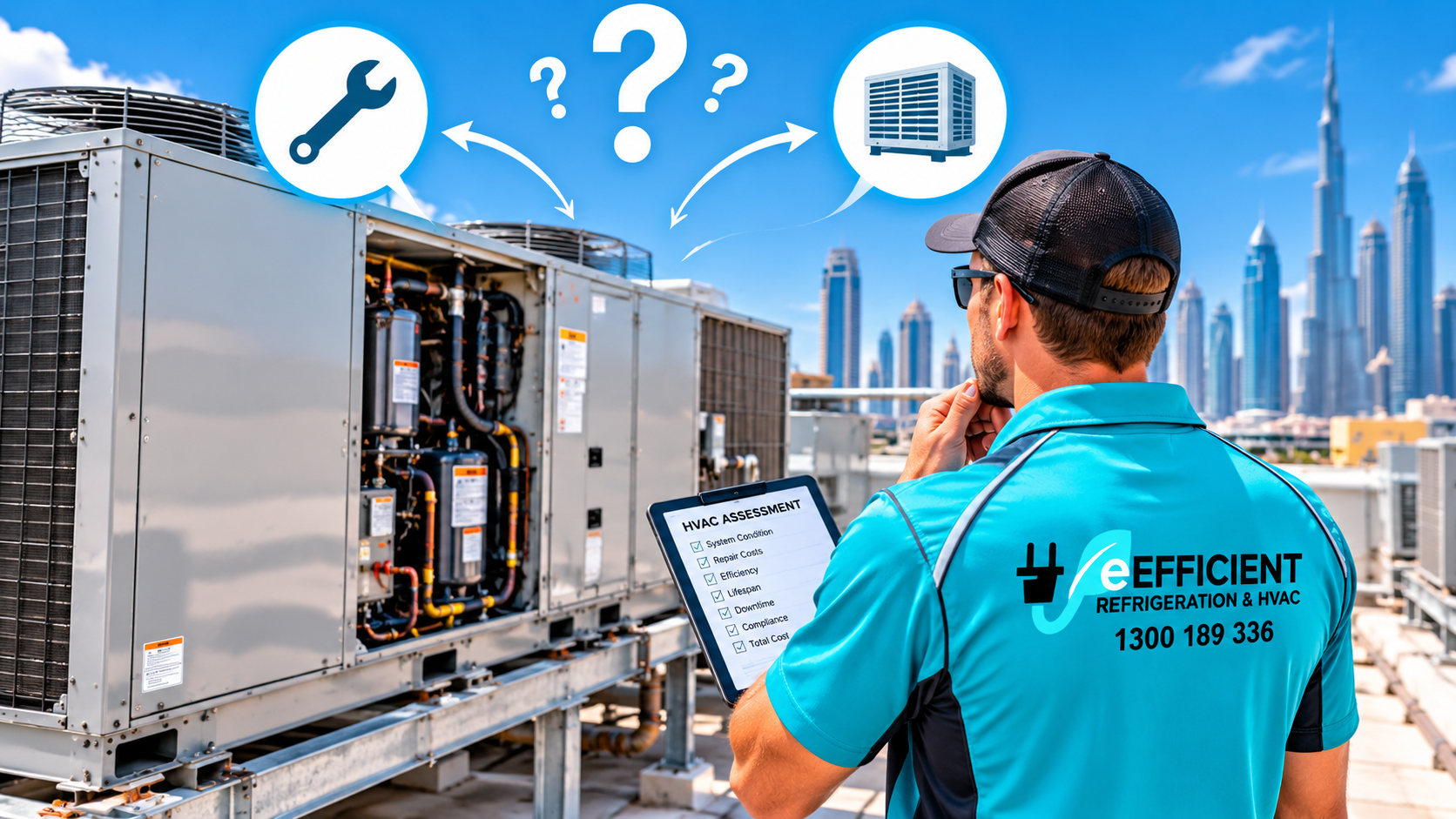
 When a commercial HVAC system starts breaking down more often, the first question is usually simple: should you repair or replace it?
The answer is not always straightforward.
A major repair does not automatically mean replacement is the right choice. Likewise, continuing to repair an ageing system may become expensive if faults are becoming more frequent and operating efficiency is declining.
For Perth and Western Australian businesses, the decision can be particularly important. Commercial air conditioning systems often operate for long periods during hot weather, placing significant demands on equipment. A system that is already struggling can become a much bigger operational problem when cooling demand increases.
Before deciding whether to repair or replace your commercial HVAC system, consider these seven questions.
1. How Old Is Your Commercial HVAC System?
The age of your HVAC equipment is an important part of the repair or replacement decision.
Commercial HVAC systems are designed to provide reliable service over many years, but components naturally wear with use. As equipment gets older, maintenance requirements can increase and replacement parts may become harder to source.
Age alone does not mean that a system needs to be replaced.
A well maintained older system may continue to perform reliably, while a poorly maintained newer system can develop significant problems.
Instead of looking only at the installation date, consider the condition of the equipment.
Ask:
• How long has the system been operating?
• Has it been regularly maintained?
• Are major components still in good condition?
• Is the system meeting the building’s cooling requirements?
• Are replacement parts readily available?
• Has the system experienced major failures?
The answers can help establish whether a repair is likely to extend the useful life of the equipment or whether replacement should be considered.
For example, replacing a worn component on an otherwise reliable system may make practical sense.
However, if several major components are reaching the end of their service life, repairing one fault may only delay another expensive repair.
2. How Much Will the Repair Cost?
The cost of the immediate repair is important, but it should not be considered in isolation.
A relatively inexpensive repair may be worthwhile if the rest of the system is operating properly.
The situation changes when the repair involves a major component or when several repairs are required at the same time.
Consider the repair cost alongside the condition and remaining service life of the system.
A business should also consider the potential cost of continuing to operate an ageing system.
This may include:
• Increasing maintenance costs
• More frequent breakdowns
• Higher energy consumption
• Reduced cooling performance
• Business disruption
• Emergency call outs
• Replacement parts
• Unplanned downtime
A repair that appears inexpensive today may not provide good long term value if the same system continues to experience problems.
This is why a professional assessment should look beyond the immediate fault.
The important question is not simply, “How much will this repair cost?”
It is also, “What condition will the system be in after the repair?”
3. Has the System Needed Frequent Repairs?
One repair does not necessarily indicate that a commercial HVAC system is nearing the end of its useful life.
Repeated repairs are different.
If your system has required multiple service visits over the past year, it may be time to look at the bigger picture.
Frequent faults can indicate that components are ageing or that the system has an underlying issue that has not been fully addressed.
Keep a record of repairs and maintenance work.
Look for patterns such as:
• Repeated compressor problems
• Recurring electrical faults
• Refrigeration issues
• Fan or motor failures
• Water leaks
• Control problems
• Repeated overheating
• Recurring airflow problems
• Unusual vibration or noise
When the same problem keeps returning, repairing the immediate fault may not address the underlying cause.
A commercial HVAC professional can investigate whether the problem is isolated or part of a wider system condition.
This distinction is important.
Replacing a failed component may restore operation. But if several other components are also showing signs of deterioration, the business may need to consider whether continued repairs are the most practical approach.
4. Is Your HVAC System Still Operating Efficiently?
A system can still be cooling a building while becoming increasingly inefficient.
This is one of the reasons energy consumption should be considered when deciding whether to repair or replace commercial HVAC equipment.
An ageing or poorly maintained system may need to operate for longer periods to achieve the required indoor temperature.
Dirty coils, restricted airflow, worn components, refrigeration problems and control issues can all affect system performance.
The result can be increased energy consumption.
If your commercial HVAC energy bill has increased without a clear change in building use, occupancy or operating hours, the HVAC system should be investigated.
Look for signs such as:
• Equipment running for longer periods
• Increasing energy consumption
• Uneven temperatures
• Reduced cooling performance
• Frequent cycling
• Changes in equipment noise
• Poor airflow
• Increasing maintenance requirements
A system that consumes significantly more energy than expected may require maintenance or repairs.
However, if the equipment is older and inefficient, replacement may provide an opportunity to improve long term operating performance.
Energy efficiency should therefore be considered alongside repair costs rather than treated as a separate issue.
5. Are Replacement Parts Still Available?
Parts availability is another practical consideration that businesses sometimes overlook.
Older commercial HVAC equipment can become more difficult to maintain when manufacturers discontinue components or suppliers have limited stock.
This can turn a relatively straightforward repair into a longer and more complicated process.
If a critical component fails and the required replacement part is difficult to source, the business may face extended downtime.
Ask your HVAC contractor:
• Are replacement parts readily available?
• Are major components still supported?
• Is the manufacturer still supplying the equipment?
• Could future repairs become more difficult?
• Are alternative components available?
Parts availability is particularly important for critical commercial facilities where HVAC downtime can affect staff, customers, equipment or business operations.
A system may still be repairable today, but the availability of parts should be considered when assessing its future reliability.
6. Will the Existing System Meet Your Future Needs?
Your building may not have the same HVAC requirements it had when the system was installed.
Changes to the building, occupancy, equipment, operating hours or business use can affect cooling requirements.
For example, a business may have:
• Increased the number of employees
• Added new equipment
• Expanded an occupied area
• Changed the use of a space
• Increased operating hours
• Added areas requiring temperature control
• Changed internal layouts
An HVAC system that was correctly sized for the building several years ago may no longer be suitable for its current requirements.
This is why replacing equipment should not simply mean selecting a newer version of the existing system.
The replacement should be assessed against the building’s current and expected requirements.
A professional HVAC assessment can help determine whether the existing system has sufficient capacity, whether its configuration remains appropriate and whether improvements to controls, distribution or other components should be considered.
Thinking about future requirements can also help businesses avoid replacing equipment only to discover later that additional modifications are needed.
7. What Will the Total Cost of Replacement Look Like?
If replacement is being considered, look beyond the equipment purchase price.
The total project cost can include much more than the new HVAC unit.
Depending on the system and site, replacement may involve:
• Equipment supply
• Removal of existing equipment
• Electrical modifications
• Refrigeration pipework
• Ductwork modifications
• Chilled water pipework
• Controls
• BMS integration
• Crane or lifting requirements
• Installation labour
• Testing and commissioning
• Water balancing
• System upgrades
• Compliance requirements
Understanding the full scope is important when comparing repair with replacement.
A replacement may require a larger upfront investment, but the business should consider this against future maintenance requirements, energy performance, reliability and expected service life.
For major commercial HVAC projects, proper planning is particularly important.
Replacing a system during an emergency can create additional pressure because the business is already dealing with a failure.
Where possible, planning a replacement before a major breakdown allows the business to assess options, obtain appropriate advice and schedule the work with less disruption.
Repair or Replace Commercial HVAC: Look at the Bigger Picture
There is no single rule that determines when a commercial HVAC system should be repaired or replaced.
The right decision depends on the condition of the equipment, the cost and frequency of repairs, system efficiency, parts availability, building requirements and the expected future performance of the system.
A repair may be appropriate when the system is generally reliable and the fault is isolated.
Replacement may need to be considered when an ageing system has frequent failures, increasing operating costs, major component problems or difficulty obtaining replacement parts.
However, these factors should be assessed together.
For example, an older system with one minor fault may still be a suitable candidate for repair.
An older system that has experienced several major failures, consumes increasing amounts of energy and requires difficult to source components presents a different situation.
This is why the repair or replace decision should be based on the condition and performance of the complete system rather than one failed component.
Do Not Wait Until a Major Breakdown
One of the biggest challenges with commercial HVAC replacement is timing.
Businesses often begin considering replacement after a major failure has already occurred.
At that point, the priority is usually restoring cooling as quickly as possible.
This can limit the available options and increase disruption to normal operations.
A proactive assessment can provide more time to plan.
If a system is showing signs of ageing or declining performance, identifying those issues early can allow a business to investigate repair and replacement options before an emergency occurs.
Warning signs may include:
• Increasing repair frequency
• Rising energy costs
• Reduced cooling performance
• Unusual noises or vibration
• Recurring refrigeration faults
• Frequent electrical problems
• Poor temperature control
• Difficulty sourcing replacement parts
• Increasing maintenance costs
These signs do not automatically mean that replacement is required.
They do indicate that the system deserves closer attention.
Consider the Cost of Downtime
For a commercial business, the cost of an HVAC failure can extend beyond the repair invoice.
A failed system can affect employees, customers, tenants, stock, equipment and daily operations.
In some environments, temperature control is particularly important.
Retail businesses, hotels, supermarkets, offices, industrial facilities, healthcare environments and other commercial sites can have very different HVAC requirements and consequences when cooling is unavailable.
This means the cost of downtime should form part of the repair or replacement discussion.
A system that is inexpensive to repair but highly likely to fail again may create greater operational risk than a planned replacement.
Conversely, replacing a system that could have provided several more years of reliable service may not be necessary.
The objective is to understand the condition of the equipment and make the decision based on the site’s actual requirements.
A Professional Assessment Can Help
If you are unsure whether to repair or replace your commercial HVAC system, start with a professional assessment.
An experienced commercial HVAC contractor can inspect the equipment, identify existing faults, assess component condition and review the system’s overall performance.
This can provide a clearer picture of what needs attention now and what may require attention in the future.
The assessment should consider more than the immediate fault.
It should look at the complete system and its operating environment.
This may include the equipment condition, controls, airflow, refrigeration performance, electrical components, mechanical components, maintenance history and building requirements.
The result can help businesses make a more informed decision about whether continued maintenance and repair is appropriate or whether replacement should be planned.
Make the Decision Before the System Makes It for You
Commercial HVAC equipment is a major part of building infrastructure.
Waiting until a system fails completely can leave businesses with limited time to make decisions and can increase the risk of operational disruption.
If your HVAC system is becoming increasingly difficult or expensive to maintain, it is worth reviewing its overall condition before the next major fault occurs.
The question is not simply whether the system can be repaired.
The more important questions are whether the repair provides reliable value, whether the system can continue meeting the building’s requirements and whether its operating costs and future maintenance needs remain manageable.
A professional assessment can help you understand those factors before making a decision.
If you are considering whether to repair or replace your commercial HVAC system in Perth or elsewhere in Western Australia, speak with a commercial HVAC professional about the condition and requirements of your system.
A planned decision can give your business more control over costs, maintenance and future HVAC performance.
Need Help Assessing Your Commercial HVAC System?
Efficient Refrigeration & HVAC provides commercial HVAC services across Western Australia, supporting businesses with maintenance, repairs, system upgrades and major HVAC projects.
Whether your system needs a targeted repair or you are considering a larger replacement project, understanding the condition of the existing equipment is the first step.
For ongoing system care, you can also use our Commercial HVAC Maintenance Checklist for Perth Businesses to help identify key areas that should be monitored as part of a preventative maintenance program.