

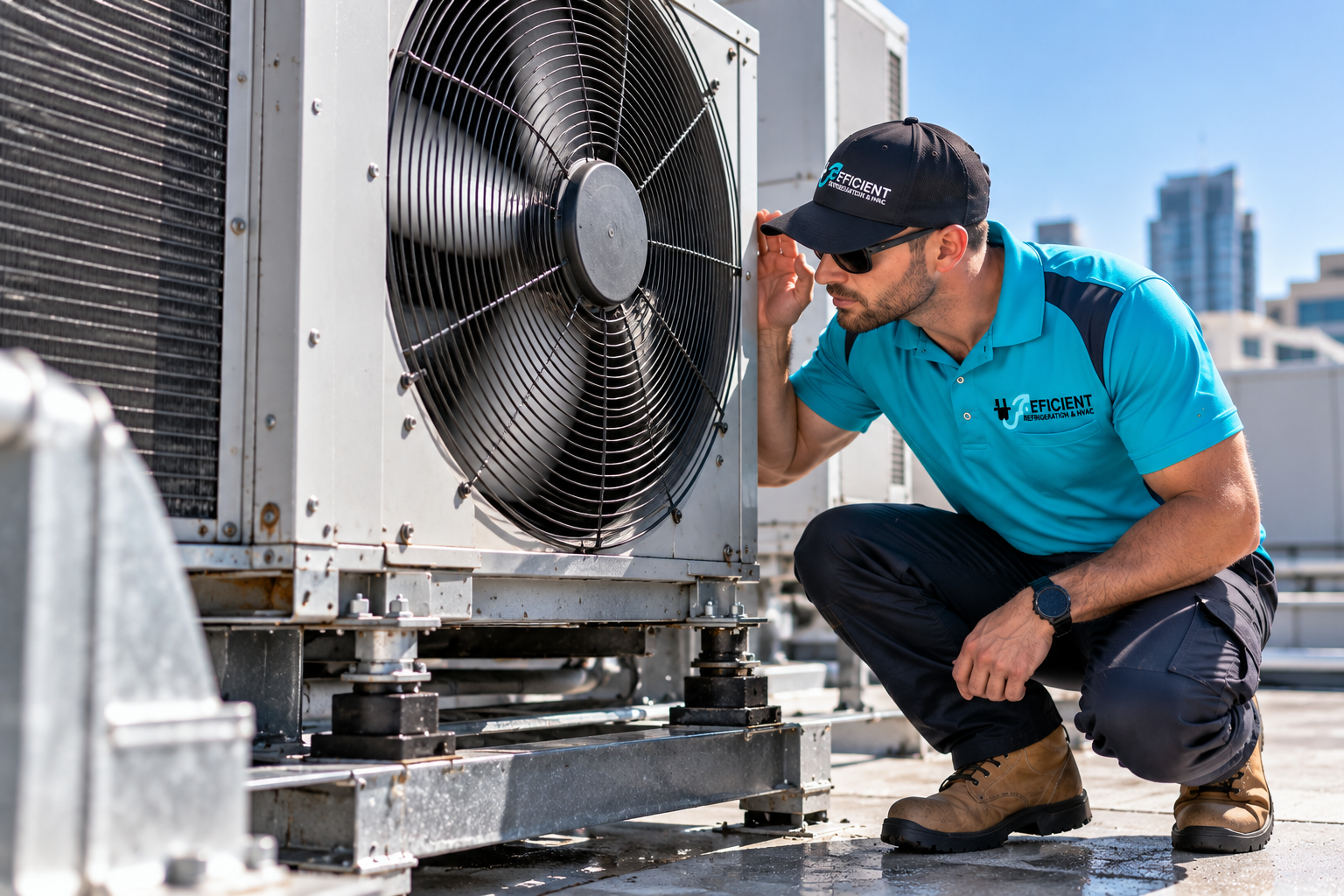
 Why Is My Air Conditioner Making a Strange Noise?
Unusual sounds can be an early warning sign that your commercial air conditioning system needs attention. If you are wondering, “Why Is My Air Conditioner Making a Strange Noise?”, the sound can provide important clues about what may be wrong.
A rattling sound may indicate a loose component, while grinding, buzzing, clicking or hissing may point to a mechanical, electrical or refrigeration issue.
Ignoring strange noises can allow a small fault to become a major breakdown. For Perth businesses, this can lead to uncomfortable indoor conditions, equipment damage, business disruption and unexpected repair costs.
In this guide, we explain the most common reasons for commercial AC making noise, what each sound may mean and when to contact a commercial HVAC professional.
Why Is My Commercial Air Conditioner Making Noise?
Commercial air conditioning systems contain several moving, electrical and refrigeration components.
These include:
• Fans • Motors • Belts • Bearings • Compressors • Pumps • Controls • Electrical connections • Ductwork
Over time, these parts can become worn, loose, dirty or damaged.
A strange noise may be caused by:
• Loose panels or screws • Fan problems • Worn motor bearings • Damaged belts • Compressor faults • Electrical issues • Refrigeration problems • Dirt and debris • Poor maintenance • Excessive vibration
The type of noise, when it happens and where it comes from can help identify the possible cause.
1. Rattling Sounds
A rattling sound is one of the most common noises reported by commercial air conditioning users.
It may sound like something is loose inside the system.
Possible causes include:
• Loose access panels • Loose screws or fasteners • Damaged fan blades • Loose ductwork • Debris inside the unit • Worn internal components
A small loose panel may create a noticeable rattling sound when the fan starts or stops.
However, a rattling noise can also come from a more serious internal problem.
If the sound becomes louder over time, the system should be inspected before the component causes further damage.
What Should You Do?
Do not open the equipment or reach inside while it is operating.
A qualified technician can inspect the panels, fan assembly, ductwork and internal components to identify the source of the noise.
2. Grinding or Scraping Sounds
Grinding or scraping noises should not be ignored.
These sounds may indicate that two components are rubbing together or that a moving part is becoming worn.
Possible causes include:
• Worn motor bearings • Damaged fan bearings • Fan blades touching the housing • A damaged fan assembly • Compressor problems • Poorly aligned components
Motor bearings can become noisy as they wear.
If the problem is not addressed, the motor may eventually overheat or fail.
A grinding sound coming from the compressor can be particularly concerning because compressors are essential to the refrigeration cycle.
Why Is This Important?
A small mechanical fault may be easier and less expensive to correct when identified early.
Continuing to operate the system while it is making a grinding sound can increase the risk of further damage.
3. Buzzing or Humming Sounds
Some humming is normal during air conditioner operation.
However, a loud, unusual or increasingly noticeable hum may indicate a problem.
Possible causes include:
• Electrical component issues • Loose electrical connections • A failing motor • Transformer problems • Compressor operation • Fan motor faults • Excessive vibration
Electrical buzzing should be treated seriously.
Commercial HVAC systems contain electrical components that should only be inspected by appropriately qualified professionals.
Warning Signs to Watch For
Arrange professional attention if the buzzing sound is accompanied by:
• Burning smells • Flickering lights • Repeated circuit breaker trips • Reduced cooling • Equipment shutdowns • Heat around electrical components
If there is smoke, a burning smell or an immediate electrical safety concern, stop using the affected equipment if it is safe to do so and arrange urgent professional assistance.
4. Hissing Sounds
A hissing noise may come from air movement, pressure differences or the refrigeration system.
In some cases, a quiet hissing sound may be part of normal operation.
However, a loud or unusual hissing sound can indicate a possible fault.
Potential causes include:
• Refrigerant escaping from a leak • Air escaping from ductwork • Pressure issues • A faulty valve • Restricted airflow • Damaged seals
A refrigerant leak may also be associated with reduced cooling performance.
The system may struggle to maintain the required indoor temperature, especially during periods of high demand.
Refrigeration faults should always be assessed by an appropriately qualified technician.
5. Clicking Sounds
Clicking can occur when a commercial air conditioner starts or stops.
A single click from a control or relay may be normal.
Repeated clicking, loud clicking or clicking without the system starting correctly may indicate a fault.
Possible causes include:
• Electrical relay problems • A faulty capacitor • Control system issues • Thermostat problems • Compressor starting difficulties • Loose electrical components
If the air conditioner clicks repeatedly but does not start, avoid repeatedly switching it on and off.
This may place additional stress on the system.
A technician can test the electrical and control components to identify the cause.
6. Squealing or Screeching Sounds
A high pitched squealing sound may indicate a problem with a belt, bearing or rotating component.
Commercial air conditioning systems that use belt driven fans may develop noise when belts become worn, loose or incorrectly aligned.
Possible causes include:
• Loose belts • Worn belts • Misaligned pulleys • Worn bearings • Motor problems • Fan issues
A damaged belt can eventually break and stop the fan from operating.
This may reduce airflow and cause the system to lose cooling performance.
Regular maintenance can help identify belt wear, alignment problems and other mechanical issues before they cause an unexpected shutdown.
7. Whistling Sounds
A whistling noise is often associated with airflow.
It may occur when air passes through a restricted or damaged part of the system.
Possible causes include:
• Dirty air filters • Blocked grilles • Closed dampers • Ductwork leaks • Incorrect airflow settings • Poorly fitted panels • Restricted return air
If airflow is restricted, the system may need to work harder to maintain the required temperature.
This can increase energy use and place additional pressure on fans and motors.
A technician can inspect the filters, grilles, dampers, ductwork and airflow settings.
8. Banging or Clanking Sounds
Banging or clanking sounds can indicate a loose or damaged moving component.
The sound may occur when the fan starts, when the system shuts down or during normal operation.
Possible causes include:
• Loose fan blades • Damaged fan assemblies • Loose internal components • Debris inside the unit • Motor problems • Compressor faults
A damaged fan blade can create vibration and place stress on the motor.
If the noise is loud or sudden, the equipment should be checked promptly.
Continuing to operate a system with a damaged rotating component may result in more serious damage.
9. Vibrating or Shaking Sounds
Vibration is another common cause of commercial AC making noise.
Some vibration is normal, but excessive movement may indicate that the equipment is not operating correctly.
Possible causes include:
• Loose mounting brackets • Unbalanced fan blades • Worn bearings • Loose panels • Damaged isolation mounts • Poorly supported ductwork • Equipment that is not level
Vibration can transfer through the building structure and make the noise seem louder than it actually is.
It may also place stress on connected pipework, ductwork and electrical components.
A technician can inspect the equipment mounting, fan balance, isolation supports and connected components.
10. The Compressor May Be Making Noise
The compressor is one of the most important components in a commercial air conditioning system.
It helps circulate refrigerant through the system so that cooling can take place.
A compressor may produce a low operating hum, but unusual sounds should be investigated.
Possible compressor related noises include:
• Grinding • Knocking • Banging • Loud humming • Repeated clicking • Excessive vibration
Compressor noise may be associated with mechanical wear, electrical problems, incorrect operating conditions or refrigeration faults.
Compressor repairs can be complex and may require specialist assessment.
Early investigation can help determine whether the issue can be repaired or whether a larger replacement decision may be required.
Can Dirty Filters Cause Commercial AC Making Noise?
Yes.
Dirty filters can restrict airflow and make the system work harder.
This may increase fan noise and cause unusual whistling or humming sounds.
Restricted airflow can also contribute to poor cooling performance and coil freezing in some operating conditions.
Commercial buildings exposed to dust, construction activity or industrial conditions may require more frequent filter inspections.
The correct maintenance schedule depends on:
• Building use • Operating hours • Indoor air quality requirements • Dust levels • Equipment type • Manufacturer recommendations • Environmental conditions
Keeping filters clean and replacing them when required can support better airflow and more reliable operation.
Can Poor Maintenance Cause Strange Air Conditioner Noises?
Poor maintenance is a common reason for commercial HVAC systems becoming noisy.
Without regular inspections, small problems can develop unnoticed.
For example:
A loose panel may become more damaged.
A worn bearing may eventually cause motor failure.
A dirty coil may reduce system performance.
A loose belt may break.
A blocked filter may restrict airflow.
A small vibration may place stress on connected components.
Preventative maintenance helps identify these issues before they become major faults.
A suitable commercial HVAC maintenance program may include checks of:
• Filters • Fans • Motors • Belts • Bearings • Coils • Ductwork • Dampers • Electrical connections • Compressors • Refrigeration performance • Controls and sensors • Mounting and vibration
Does Strange Noise Mean My Air Conditioner Needs Replacing?
Not always.
Some noise problems can be corrected through adjustment, cleaning, tightening, lubrication, repair or replacement of a small component.
However, replacement may need to be considered when:
• The equipment is old • Major components are failing • Repairs are becoming frequent • The system is inefficient • Replacement parts are difficult to obtain • The equipment cannot meet the building’s cooling requirements • Repair costs are becoming too high • The system has experienced repeated breakdowns
A professional assessment can help determine whether repair, refurbishment or replacement is the most practical option.
The decision should consider the equipment condition, operating costs, reliability, repair history and future business requirements.
What Should You Do When Your Commercial AC Makes a Strange Noise?
If you are asking, “Why Is My Air Conditioner Making a Strange Noise?”, a noisy system may be working harder than it should and could be showing signs of an underlying fault.
If your commercial air conditioner is making an unusual sound, take note of the following:
Identify the Type of Noise
Is it:
• Rattling • Grinding • Buzzing • Hissing • Clicking • Squealing • Whistling • Banging • Vibrating • Humming
Check When the Noise Happens
Does it happen:
• When the system starts? • When the system stops? • During cooling? • During heating? • When the fan speed changes? • All the time?
Check for Other Warning Signs
Look for:
• Reduced cooling • Poor airflow • Water leaks • Burning smells • Unusual vibration • Frequent shutdowns • Higher energy use • Error messages • Repeated circuit breaker trips
These details can help a technician identify the possible cause more quickly.
Do not attempt to open, adjust or repair commercial HVAC equipment yourself.
Electrical, refrigeration and mechanical components require appropriate skills, tools and qualifications.
When Should You Call a Commercial HVAC Professional?
If you are asking, “Why Is My Air Conditioner Making a Strange Noise?”, it is important to pay attention to what the system is telling you. You should arrange professional HVAC service when:
• The noise is loud or unusual
• The sound is getting worse
• The system is not cooling properly
• The equipment is vibrating excessively
• There is a burning smell
• The system repeatedly switches off
• The circuit breaker trips
• Water is leaking from the equipment
• The compressor is making unusual sounds
• The same noise keeps returning
A strange noise should not be treated as normal simply because the system is still producing cool air.
The equipment may continue operating while a component is wearing out.
Early attention may help prevent a larger breakdown and reduce disruption to business operations.
Why Perth Businesses Should Not Ignore HVAC Noise
Commercial air conditioning systems in Perth may operate for long periods during hot weather.
When cooling demand is high, even a small equipment fault can become a serious problem.
If you are asking, “Why Is My Air Conditioner Making a Strange Noise?”, a noisy system may be working harder than it should and could be showing signs of an underlying fault.
This can affect:
• Indoor comfort • Staff productivity • Customer experience • Equipment reliability • Energy performance • Maintenance costs • Business operations
For commercial buildings, reliable HVAC operation is important.
A strange noise may be the first warning that the system needs inspection or maintenance.
Prevent Strange HVAC Noises With Regular Maintenance
Regular commercial HVAC maintenance can help reduce the risk of unexpected noise and equipment failure.
A preventative maintenance program should be designed around the equipment, building use and operating conditions.
It may include:
• Cleaning or replacing filters • Inspecting fans and motors • Checking belts and bearings • Inspecting electrical components • Cleaning coils • Checking airflow • Inspecting ductwork • Checking vibration and mounting • Testing controls • Assessing compressor operation • Checking refrigeration performance • Recording developing faults
Maintenance is not only about fixing existing problems.
It is also about identifying early warning signs before they lead to expensive repairs or unplanned downtime.
Final Thoughts
If your commercial air conditioner is making a strange noise, do not ignore it.
Rattling, grinding, buzzing, hissing, clicking, squealing and banging sounds can indicate problems with fans, motors, belts, bearings, compressors, electrical components or refrigeration systems.
Some issues may be minor, while others can lead to serious equipment failure.
The safest approach is to arrange a professional inspection as soon as unusual noise appears.
Regular commercial HVAC maintenance can also help identify worn components, airflow problems and developing faults before they affect business operations.
For a practical guide to keeping your system in good condition, read our Commercial HVAC Maintenance Checklist for Perth Businesses.
Need Help With Commercial AC Making Noise?
Efficient Refrigeration & HVAC provides commercial HVAC maintenance, repairs and refrigeration services across Perth and Western Australia.
Our team can inspect commercial air conditioning systems, identify unusual noises and help businesses maintain reliable cooling and ventilation.
Contact Efficient Refrigeration & HVAC to discuss your commercial HVAC maintenance or repair requirements.