
Why Is My Commercial HVAC Leaking Water?
Why Is My Commercial HVAC Leaking Water?
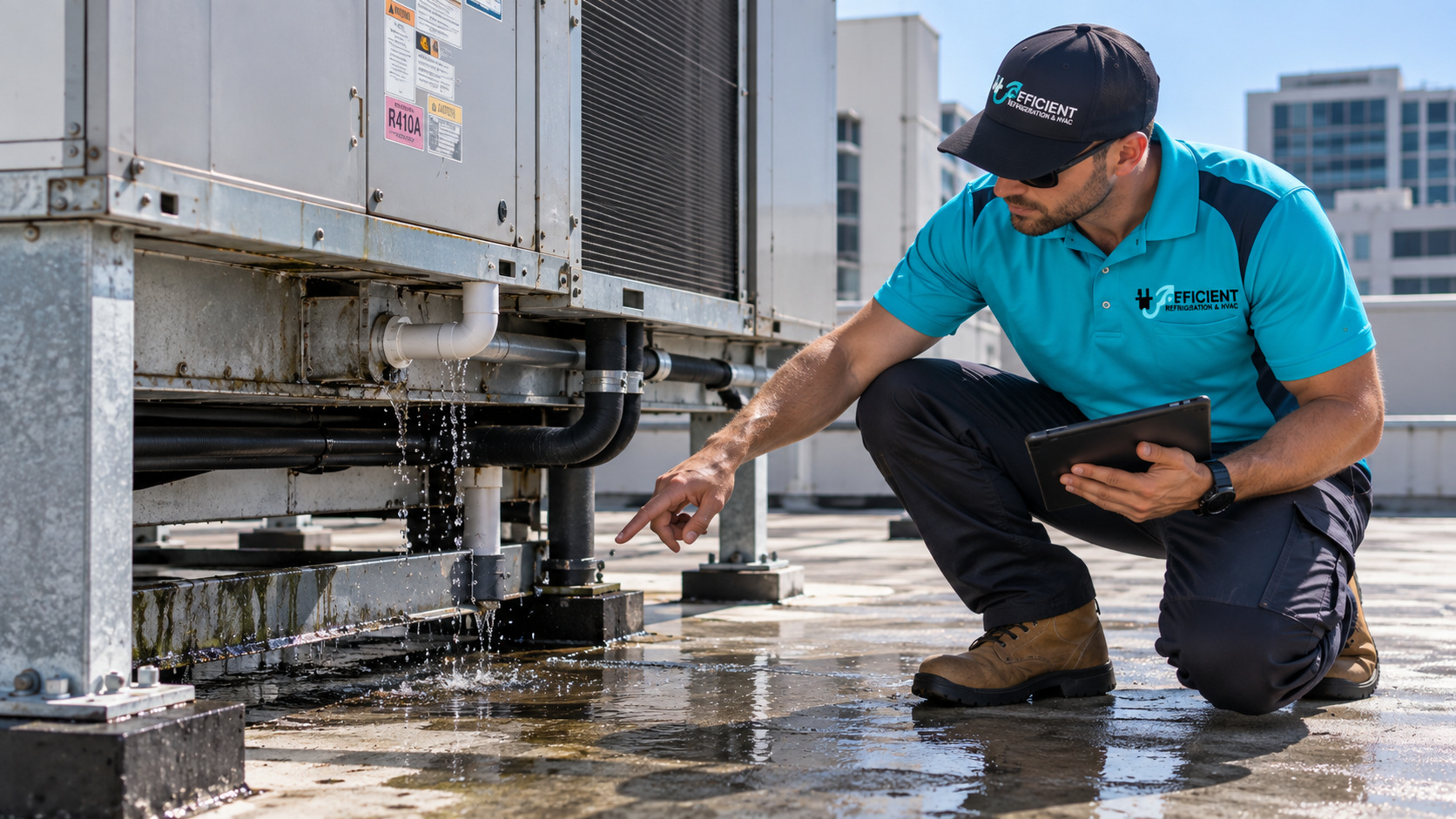 Water leaking from a commercial HVAC system is not something to ignore.
A small amount of condensation can be normal during cooling. However, water appearing in the wrong place can indicate a drainage problem, restricted airflow, a frozen coil, a damaged drain pan or another HVAC fault.
For a commercial building, the consequences can be more serious than an uncomfortable room. A leak can damage ceilings, walls, flooring, electrical components, stock and other equipment.
So, why is your commercial HVAC leaking water?
In this guide, we look at the most common causes, what the warning signs mean and when you should call a commercial HVAC professional.
How Does Water Form in a Commercial HVAC System?
Before looking at the causes of a leak, it helps to understand where the water comes from.
When warm, humid air passes over a cold evaporator coil, moisture in the air can condense on the coil.
That moisture needs to be collected and removed through the HVAC system’s condensate drainage system.
In a properly operating system, condensate flows into a drain pan and then away through a drain line or condensate pump where required.
The problem starts when the water cannot drain correctly.
A blocked drain, damaged drain pan, faulty pump or restricted airflow can cause water to build up.
Eventually, that water may overflow or appear in areas where it should not be.
Commercial HVAC systems can vary significantly, so the exact cause needs to be assessed according to the equipment and installation.
1. A Blocked Condensate Drain
A blocked condensate drain is one of the first things a technician should investigate when a commercial HVAC system is leaking water.
Dust, dirt, algae and other debris can build up inside the drainage system.
Over time, the blockage can restrict or stop the flow of condensate.
When the water cannot leave the system, it can collect in the drain pan and eventually overflow.
The location of the water can provide an important clue.
For example, water may appear underneath an indoor unit, around an air handling unit or on a ceiling below the HVAC equipment.
Regular maintenance can help identify drainage problems before they become disruptive.
What Are the Warning Signs?
Look for:
• Water around the HVAC unit
• Overflow from a drain pan
• Slow drainage
• Damp areas around the equipment
• Water stains on ceilings or walls
• Unusual moisture near the system
A blocked drain may seem like a minor problem, but leaving it unresolved can allow water damage to develop.
2. Dirty Filters Can Restrict Airflow
Air filters play an important role in commercial HVAC systems.
When filters become heavily loaded with dust and debris, airflow can become restricted.
Restricted airflow can affect how the system operates and may contribute to coil freezing in some conditions.
When the system is switched off or the coil begins to thaw, the resulting water can exceed what the drainage system is designed to handle.
This can contribute to water escaping from the HVAC system.
Dirty filters can also affect overall system performance.
The correct filter inspection and replacement schedule will depend on the equipment, building and operating environment.
A commercial building exposed to significant dust may require more frequent attention than a cleaner office environment.
3. The Evaporator Coil May Be Frozen
A frozen evaporator coil can also contribute to water leaking from a commercial HVAC system.
During normal operation, moisture can collect on the cooling coil and drain away.
However, if the coil becomes excessively cold and ice forms, the situation changes.
When the ice eventually melts, a large amount of water can enter the drain pan over a short period.
If the drainage system cannot handle the water, it may overflow.
A frozen coil can have several possible causes.
These may include:
• Restricted airflow
• Dirty filters
• Coil contamination
• Refrigeration system problems
• Control issues
• Other equipment faults
This is why simply removing the visible ice may not solve the underlying problem.
The cause needs to be identified.
4. The Drain Pan May Be Damaged
The drain pan sits beneath the cooling coil and collects condensate.
If the pan is damaged, corroded, cracked or incorrectly positioned, water may not flow into the intended drainage system.
Instead, it may escape around the equipment.
This can be particularly concerning when HVAC equipment is installed above ceilings or near sensitive areas.
A small leak may remain unnoticed until it creates a visible ceiling stain or causes damage to surrounding materials.
During professional maintenance, technicians can inspect accessible drain pans and associated drainage components for signs of deterioration.
If a drain pan is damaged, cleaning the drain alone will not solve the problem.
The damaged component may need to be repaired or replaced.
5. The Condensate Pump May Have Failed
Some commercial HVAC systems rely on condensate pumps to move water away from the equipment.
This is particularly useful where gravity drainage is not practical.
If the pump fails, water can accumulate inside the system.
The result may be an overflowing drain pan and water leaking into the surrounding area.
Possible causes of pump problems can include:
• Mechanical failure
• Electrical faults
• Blockages
• Float switch problems
• Poor maintenance
If a system uses a condensate pump, the pump should be included in the maintenance program.
A technician can check whether it operates correctly and whether the associated drainage path is clear.
6. Poor Drainage Can Cause Water to Back Up
Not every drainage problem starts with a blockage.
The drainage system itself may have installation or design issues.
For example, incorrect pipe fall, damaged pipework or unsuitable drainage arrangements can affect how condensate leaves the HVAC system.
A drain line that does not allow water to flow correctly may result in water backing up.
This can become more noticeable during periods of heavy cooling operation.
If a commercial HVAC system repeatedly develops water leaks even after the drain has been cleaned, the drainage arrangement should be investigated more thoroughly.
Repeated leaks usually mean the underlying cause has not been resolved.
7. Dirty Coils Can Affect System Performance
Commercial HVAC coils collect dust and debris over time.
When coils become dirty, heat transfer can be affected.
This can reduce system performance and increase the workload on the equipment.
Dirty coils can also contribute to operating conditions that increase the risk of other problems.
This is why coil inspection and cleaning should form part of an appropriate commercial HVAC maintenance program.
Cleaning should be performed using methods appropriate for the equipment.
8. Refrigeration Problems May Be Involved
Sometimes a water leak is not simply a drainage problem.
A refrigeration system fault can affect how the cooling system operates.
For example, incorrect refrigerant conditions can contribute to abnormal coil temperatures and ice formation.
When that ice melts, excess water can enter the drainage system.
However, refrigeration faults should not be diagnosed by simply looking for water.
A qualified technician needs to assess the system and determine whether refrigeration performance is contributing to the problem.
Refrigerant work should always be handled by appropriately qualified professionals.
9. Humidity Can Increase Condensation
Humidity also plays a role in commercial HVAC systems.
When humid air comes into contact with cold surfaces, condensation can form.
In some commercial environments, the moisture load can be significant.
Restaurants, hospitality venues, industrial facilities and other buildings with high internal moisture loads may place greater demands on HVAC systems.
If the system cannot properly manage the moisture load, condensation problems may occur.
This is another reason why HVAC systems need to be assessed according to the actual building environment rather than using a one size fits all approach.
Can a Commercial HVAC Water Leak Cause Damage?
Yes.
A water leak should be treated seriously, particularly when HVAC equipment is located above ceilings, near electrical components or close to valuable equipment.
Potential consequences include:
• Ceiling damage
• Wall damage
• Damaged flooring
• Electrical risks
• Damage to stock or equipment
• Mould and moisture problems
• Disruption to business operations
• More expensive repairs
The longer a leak continues, the greater the potential for damage.
If water is reaching electrical components or other potentially hazardous areas, the affected equipment should be treated as a safety concern and assessed by an appropriately qualified professional.
What Should You Do If Your Commercial HVAC Is Leaking?
If you notice water around your commercial HVAC equipment, do not simply wipe it up and assume the problem is solved.
Start by protecting people, equipment and property from the immediate effects of the leak.
If it is safe to do so, identify where the water is coming from and note when the leak occurs.
For example, does it happen only when the system is cooling?
Does it occur continuously?
Is the water appearing underneath the equipment or further away?
These details can help a technician investigate the problem.
If water is near electrical components, do not attempt to inspect or repair the equipment yourself.
Commercial HVAC systems can contain electrical and refrigeration components that require qualified professionals.
How Can Regular Maintenance Prevent Water Leaks?
Preventative maintenance can help identify conditions that may contribute to HVAC water leaks.
A suitable maintenance program can include checks of:
• Air filters
• Evaporator coils
• Condensate drains
• Drain pans
• Condensate pumps
• Airflow
• Fans and motors
• Controls
• Refrigeration performance
• Accessible ductwork
Maintenance frequency should be based on the equipment, operating hours, building use and environmental conditions.
Regular maintenance is also about more than preventing leaks.
It can help businesses identify developing problems before they result in major breakdowns.
Why Perth Businesses Should Take HVAC Leaks Seriously
Commercial buildings in Perth can place significant demands on cooling systems, particularly during periods of high temperatures.
HVAC systems may operate for extended periods to maintain comfortable indoor conditions.
When equipment is working hard, maintenance becomes even more important.
A small drainage problem can quickly become a larger issue if it is left unattended.
For businesses, the cost is not limited to the HVAC repair itself.
Water damage, disruption, damaged stock and unexpected downtime can all increase the overall cost of the problem.
That is why responding early can make a difference.
When Should You Call a Commercial HVAC Professional?
You should arrange professional attention when:
• Water continues to leak after the system has been operating
• The drain repeatedly blocks
• The system develops ice
• Cooling performance has decreased
• Water is reaching electrical components
• There is significant water around the equipment
• The system is making unusual noises
• The same leak keeps returning
• The HVAC system is experiencing repeated faults
A recurring leak should not be treated as a normal part of HVAC operation.
The visible water may only be a symptom of a deeper problem.
A professional technician can assess the equipment, drainage system and operating conditions to identify the underlying cause.
Don’t Ignore a Commercial HVAC Water Leak
A leaking commercial HVAC system can have a simple cause, such as a blocked condensate drain.
However, it can also indicate restricted airflow, a frozen coil, a failed condensate pump, damaged drainage components or a refrigeration system problem.
The important thing is to identify the cause before the problem becomes more serious.
Regular commercial HVAC maintenance can help businesses identify drainage, airflow and equipment problems early.
It can also support reliable system performance and help reduce the risk of unexpected disruption.
For more information about maintaining commercial HVAC systems, read our guide:
Commercial HVAC Maintenance Perth: How Preventative Servicing Protects Business Operations
You can also learn more about structured HVAC maintenance in our:
Need Help With a Commercial HVAC Water Leak?
If your commercial HVAC system is leaking water, do not wait for the problem to become a major disruption.
Efficient Refrigeration & HVAC provides commercial HVAC maintenance, repairs and refrigeration services across Perth and Western Australia.
Our team can assess commercial HVAC systems, identify potential faults and help businesses maintain reliable cooling and ventilation.
Contact Efficient Refrigeration & HVAC to discuss your commercial HVAC maintenance or repair requirements.